Tuesday, December 14, 2010

Cantique de Noel

Adolphe Adam
During Christmas time, we heard & listened to many songs & carols year after year. Some of them are light-hearted, some of them are joyful, some of them are solemn. The most popular one among them perhaps is the "Silent Night". But none of them is so noble & holy as Cantique de Noel (O Holy Night) by Adolphe Adam.

Adophe Adam was a prolific composer but is chiefly remembered nowadays for the ballet Giselle (吉賽兒) & Le Corsaire (海盗). Giselle is considered one of the five greatest ballets. The ballet tells the story of a peasant girl named Giselle whose ghost, after her premature death, protects her lover from the vengeance of a group of evil female spirits called the Wilis. Le Corsaire is a ballet loosely based on the poem "The Corsair" by Lord Byron (拜倫). Some dances in Giselle & Le Corsaire are used often in ballet competitions for male & female dancers.

O Holy Night has achieved well-deserved popularity. However, most people don’t know the author is Adophe Adam, who was also the composer of Giselle. I have listened to this song many times before in Taiwan & the US. But none like the experience I got in San Francisco, an evening of 1965. I walked around the Union Square & suddenly heard this tune from a nearby cathedral. I just froze & watched the steeple of the church and its background sky with stars. I stood there & finished listening to the music. I don’t know the lyrics at that time but somehow the music touched the bottom of my heart. Music is truly a universal language, a precious part of our civilization. Since then, year after year, I went for my personal business. But as Christmas time comes every year, this tune always reminds me of that moment in San Francisco, my heart is still there.

Here Placido sang the French version & Luciano did the same for English translation in the following weblink:


Placide Cappeau's Cantique de Noël
Minuit, chrétiens, c'est l'heure solennelle,
Où l'Homme-Dieu descendit jusqu'à nous
Pour effacer la tache originelle
Et de Son Père arrêter le courroux.
Le monde entier tressaille d'espérance
En cette nuit qui lui donne un Sauveur.
Peuple à genoux, attends ta délivrance.
Noël, Noël, voici le Rédempteur,
Noël, Noël, voici le Rédempteur !

John Sullivan Dwight's English Version
O holy night! The stars are brightly shining,
It is the night of our dear Saviour's birth.
Long lay the world in sin and error pining,
'Til He appear'd and the soul felt its worth.
A thrill of hope the weary world rejoices,
For yonder breaks a new and glorious morn.
Fall on your knees! O hear the angels' voices!
O night divine, O night when Christ was born;
O night divine, O night, O night Divine.

PS:
"O Holy Night" ("Cantique de Noël") is a well-known Christmas carol composed by Adolphe Adam in 1847 to the French poem "Minuit, chrétiens" (Midnight, Christians) by Placide Cappeau (1808–1877), a poet, who had been asked by a parish priest to write a Christmas poem. Unitarian minister John Sullivan Dwight, editor of Dwight's Journal of Music, created a singing edition based on Cappeau's French text in 1855. In both the French original and in the familiar English version of the carol, the text reflects on the birth of Jesus and of mankind's redemption. This song is said to have been the first music broadcast on radio.

Monday, November 22, 2010

Beethoven's 5th


Chinese Adage: “人生無常, 死生有命, 富貴在天”. It is the Fate that something human being can not control. The whole world is a subject of probability. How do we exist? Why are we here? These are some questions most people ask sometime in their lifetime. If we think logically, it all boils down to a matter of probability. Here is one scenario most people agree. If for some reason on the day of our conception, our parents had a bad day & deviated or diverted from their routines, we would have vanished into a thin air & the history after that will be quite different. Let’s imagine what history would have been if there were no Muhammad, Genghis Kahn, Napoleon or Hitler. Since the existence of every human being is a random event, the history is also a result of a sequence of random events. Of course, the world will keep going on without Napoleon or Hitler. It is like Brownian movement. Microscopically, it is a different moving pattern for each individual molecule. However, macroscopically it is the same old liquid exhibits the same properties to the outside universe. Because of the random nature, people very often feel powerless. People pray when they encounter something unpredictable or face something unknown to them. To whom do people pray? It has to be something supreme and so the creation of god and religion.

Even we are powerless facing so many unknowns such as when we will die, we still manage to live a decent life, work, play, make fun & achieve something we call milestone or breakthrough. It is in this context, we will listen to Beethoven’s 5th & offer some consolation & interpretation.

Beethoven is considered immortal mainly due to his three major compositions: Symphony #3, #5 & #9. The 5th may not be the best, however, it is the most well-known & famous symphony. It is the emblem of the classical music. If you don’t know anything about a particular symphony, you can safely assume it has four movements although there are some exceptions. The 5th is no exception. Sometime people think it has three movements. This is mainly due to the confusion caused by the missing of a pause between 3rd & 4th movement. In other words, there is just a long note between the end of the 3rd movement & the beginning of the 4th movement. Here I pick the version performed by Herbert von Karajan, a famous German conductor. The link is:

https://www.youtube.com/watch?v=P08rkJ5Ugf0

Note: It is better to open another window (window explorer) to play music, so you can cross reference between the text and music time line.

The 1st movement

To our remote ancient ancestors, the Mother Nature imposed on them a lot of unknowns. They were under a tremendous pressure to survive. The imposition is called Fate. Here Beethoven’s motif: . . . -, Fate knocks the door. It is everywhere throughout the movement. The second theme is the response of our ancestors to the Fate. It is soft, fragile, timid and subservient.
0:00-0.45: 開門見山,命運之神以排山倒海之勢,充塞四方. It came down to knock people’s door.
0.46-1.07: It was a soft response of human being, timid and subservient.
1.08-1.24: There was no negotiation between the Fate & our ancestors.
1.25-1.50: Fate prevailed and come to knock the door again.
2.08: 人類在命運之神的肆威下, 委曲求全.
2.49: 人們喘一口氣, reposed and stood up again.
3.54: 人與命運之對話及 negotiatioon.
4.26: Led by oboe, 人與命運維持短暫的和平.
4.40: Fate imposed again and people responded meekly.
5.00: 人與命運之對話 again.
5.25: Fate walked away arrogantly and people followed sheepishly.
6.40: Fate had a last say.
6.53-7.07: Fate had a last word indeed.

The 2nd movement

Our ancestors found the solace from the religion. They found the God & interpret it in different ways. They found the way to live harmoniously with the universe. They created, invented things and produced offspring.
7:10: People escaped and found god.
8:03: They praised the god, sang hymns and prayed.
8:20: They seemed to get the response from god. They elated and thanked graciously.
8:40: People meditated and maintained faith.
9:54: Repeat the experience of 8:03. People enforced their faith.
10:32: People led decent lives with new faith.
10:58: They built temple, cathedral, mosque, and synagogue.
12:00: People searched for the true meaning of god.
12:51: Reformation, rejuvenate the belief and faith.
13:15: God had different meaning to different people. People tried to find their own god.
14:13: People found their own god.
15:03: Revelation and thankful to god
15:53-16:37: Resurrection

The 3rd movement

Our ancestors found themselves. They entered Renaissance, discovered new lands and the New World. They created the age of reason and enlightenment. However, they were groping to find a way to harness the nature to relieve the human labor and his relative position in the universe.

16:45: The theme represents the grope and probe by people.
17:02: French horns reiterate the Fate theme, but with a softer tone, more manageable fashion.
18:24: People found time to enjoy life and do something fun. They entered Renaissance and found classical music.
19:04: They found true human spirit and the meaning of Reason, liberty, equality, fraternity and all men are created equal.
19:45: People were groping and probing for something new.
20:01: Fate reasserted itself but with its mellow tone.
20:49: The end of the 3rd movement and enter the 4th movement, a new age for human being.

The 4th movement
Our ancestors eventually found way to harness the power of nature and the origin of species.

21:00: Something was being developed. People groped & probed in the dark. Went right, left, up, down and gradually found a way out of the pit.
21:23: Finally, human being found a new way to harness energy, a steam engine. A triumph of a new technology led to the Industrial Revolution. Here Beethoven gave us the Ode To Triumph.
22:00: Human being also discovered the evolution, the origin of species.
22:26: All other applications followed, locomotive, train, steamship, social Darwinism etc.
22:48: This was the joyful dance of human beings.
23:04: People found the impressionism in art.
23:30: People found the romanticism in music.
24:57: Something was being developed again.
25:10: People were groping again in the bottom of the pit, Oersted, Ampere, Henry, Gauss, Lenz.
25:29: Finally, Faraday, Maxwell, Hertz and Marconi came out of the pit. It was the age of electricity and radio, another Ode To Triumph.
25:54: This was another breakthrough for human being.
26:06: All sorts of applications followed.
26:35: People dance joyfully.
26:57: People kept charging ahead and forward.
27:56: Here came the six loud chords. They represented the six milestones of the civilization: Relativity/Quanta, bulb/phonograph/movie, car/airplane, double helix/DNA, moon landing, computer/Internet.
28:03: People found a new birth of freedom. Ahead was a grand, wide-open field extended to the horizon.
28:22: Music had to reach an end. The emotion and crescendo dealing with the Fate were built so high.
28:50: Here Beethoven put the brake to the music.
29:18: The start of the ending.
29:28: It requires about 30 loud chords to defuse the emotion. No other symphonies dare to exceed this number.
29:58: The true ending of the human drama.


The Beethoven’s 5th, 史詩般的交響曲, is the epitome in the world of symphony, a jewel of classical music. This symphony was etched on a gold record stored inside the Voyager spacecraft sailing outside the solar system since 1978. We don’t know when & where it will be picked up by some intelligent beings, perhaps some million years later in a remote corner of some other galaxy. At the moment of the Voyager leaving the solar system, it took a final photo of our solar system. The photo shows a tiny Pale Blue Dot in a completely void background. It is the Earth, a planet covered with water & the lands are just some little mountains & hills. It looks so tiny & lonely in the sea of universe. It is our home, a home sweet home.

人類雖然創造了燦爛的文明, 但仰望星空, 無垠無边. 時間空間, 沒有起始, 沒有終場. 我們深覺人類的 渺小和無助, 感恩節前夕, 這种感觸 特別深刻. 在浩翰的宇宙中,這一小藍點的存在似乎是一個奇蹟, 也是一种恩典. 在此讓我們 以最誠摯的心, 感謝上蒼, 這命運之神.

Friday, November 5, 2010

In Memory of Mark Yang


In October of 2010, we lost Joan Sutherland, Paul, the Oracle (Octopus) and our classmate Mark Yang. Indeed, it was a sad month. The world keeps going on & the best we can do is to remember how they changed & influenced us in one way or another. Remember how much joy & happy hours they gave us that sometime we took them as granted. Instead of dwelling in a mourning state, we take pride to have a classmate like Mark Yang & try to memorize him as a scholar, intellect & our classmate. Here I browsed through my photo albums & collected some photos in sequence & presented on YouTubes with a song of farewell. I consider this my way of remembering him & knowing that our email communication & NTUEE64 blog will never be the same without our Mark Yang.

We can access the video via the following link:
https://drive.google.com/file/d/0B3Kwp81ksqfMMHRsLXVHUUNNblk/edit?usp=sharing

PS0: Some photos are the snapshots of some video created in 2007 by 洪 敏 弘 & 孫 芳 德. Their contributions are greatly appreciated.

PS1: The tune was taken from “Ashokan Farewell “ by Jay Ungar. It was used extensively in the TV series, Civil War. I watched it in 1990 & was deeply moved by the tune. I think it is proper & fitting to use it here. Music is truly a universal language.

Sunday, October 3, 2010

2007班友歡聚遊娜威

少時上課同堂,晚來滄海同舟。
酬勞作母親的辛勞
沿途青山翠谷。一片世外桃園。


梵谷美術館


我們乘坐的遊輪

Smile! 請注意孫芳德身上掛的攝影機。

李純儀夫人葉公範坐輪椅與我們同遊。

Tvinde大瀑布。不時還有女鬼從墳墓裡爬出來唱歌助興。(In the very center of this picture. Pleace click the image to see her in the enlarged picture.)
--------------------------------
我與小慈的這次2007EE64班團聚應該從在Amsterdam見到林勝彥夫婦開始。這非常難得,因為沒有任何一家比他們家跟我們班更親的了。林勝彥夫人林衍秀是林幸峰的妹妹。當年我們班上有妹妹的不少,想牽線的也一定有人。萬三就有意幫他妹子在班上找一個成龍快婿。可惜沒成功。我們兩家約好早兩天到,在Amsterdam機場見面。我提早到是怕如果選在當天到,萬一飛機脫班,趕不上上船,就成了進退兩難。張葳春,吳振和,林幸峰敢選在當天到達,真是勇氣可嘉。其餘的八家早在三天前已先參加陸上旅遊團。「一不作,二不休。」周遊列國。

既然飛機準時到了,我們正好利用這兩天在荷蘭走走。我建議坐火車到Rotterdam,我想看看歐洲最大的港口。而林家說Amsterdam梵谷美術館是他們的第一優先。兩家文化高下,不言而喻。我們先到梵谷美術館,這個館真的是很漂亮,氣派。進得屋來,二林贊不絕口,看了還要買。梵谷一生貧困坎坷,他怎能料道死後有這麼多的崇拜者?我們從Amsterdam乘火車到鹿特丹,來回都很舒適,沿途的景色也十分宜人。可惜現在是秋天,看不到荷蘭有名的花海。鹿特丹真不愧為歐洲第一大港。我們乘小船遊港,一片寧靜,看不到繁忙。這港像一條長河,兩岸陳列倉庫,貨櫃,儲油筒。許多貨櫃都有中文字。也覺得是一種驕傲。

上遊輪是八月二十六號下午。這是小慈與我第一次cruise,想不到船艙麻雀雖小,設備齊全,有自己的衛浴。艙分三等,我家訂的是二等艙,有個可以看海的圓窗。安艙後的第一件大事就是赴船長的晚宴。正要找班友,就發現「哪裡有聲音,哪裡就有阿牟」。一下子十三家都聚齊了。張葳春,孫芳德還是畢業後第一次相見。依稀可以看出當年的容貌。孫芳德這次旅遊好像只有一個目的,就是用他最新款的攝影機為大伙兒拍影。他並不是拍拍就算了。事後把它整理成一片磁牒,配上古典音樂,寄給每家一份。大有當年讓我們抄他電機機械作業的慷慨。

要不是我最近常回台灣,大多數在台灣的班友也都三十几年沒有見到了。雖然大家都可以說是不負當年之志,但多數事業巔峰已過,「好漢不提當年勇」,「且道天涼好個秋。」但也有例外,洪敏弘始終不忘提醒長年在美的班友,要多報效台灣。而張葳春也一直希望大家能投資他的電腦硬體專利,一齊打拼。女士們倒是能一見如故,有說不完的家常鎖事。沒多久,各家的現況都已交換完畢。在坐的個個都家庭美滿。說也奇怪,班上超過兩個子女的家庭幾乎都參加了這次的團聚。為的是酬勞作母親的辛勞?不過下一代唸電機的不多。可憐天下父母心,還是依聯考分數排志願,讀醫科的佔多數。倒是班上的天字第一號,495301,李純儀的女兒拿到UCBekeley電機的PhD。其女能在其父身上看到電機的魅力,是本班的光榮。

這次挪威八天之行,要看的是沿海的城市。到了每個城市,我們都有下船「自由行」的時間,或港口,或街道,或公園,或廣場。大家談天說地,陳正一的笑容,何瑜笙的無憂無慮,大家互相學習。子曰︰三人行,必有我師焉。看到的都是白色的洋房,一片安詳。完全不像這是我高中心目中英雄,傑克倫敦筆下「海狼」生長的地方。倒是在Olso船隻陳列館裡可以體會出古代航海的艱辛。我坐在最豪華的郵輪中看大海,仍然感到海洋的無邊,無際,無情。這還是天氣好的日子。古人出海,沒有氣象預測,遇到狂風巨浪的機會一定不少。他們的一葉偏舟如何渡過?小時候唱兒歌,「天這麼黑,風那麼大,爸爸捕魚去,為什麼還不回家?」有多少時候爸爸就再也回不來了。
在地圖上可以看出來,挪威沿海呈鋸齒狀。到處都是天然的深水港。我們下船最久,大伙兒在一起走路最長的是Flam,這個小城雖然靠海,但在挪威的中部。由一條一百多公里的狹長海灣與北海相連。我們一直都坐在船頭欣賞船在海灣裡穿過一山又是一山的峽景。挪威的山都是火成岩,也就是大片的硬石頭,已有二億五千年的歷史。台灣的山只有二百五十萬年的歷史。是歐亞板塊與菲律賓板塊所擠壓而隆起的,有大面積的水成岩。比較容易鬆動。挪威人在這石頭山上開了一條鐵路,號稱是世界上最難的鐵路工程之一。引以為傲。我們也都買票上車。看到了有名的Tvinde 大瀑布。不時還有女鬼從墳墓裡爬出來唱歌助興。沿途青山翠谷。一片世外桃園。導遊說這原有兒有一百多戶人家,不過現在只剩下二十几戶。住這麼好的地方還要搬走?有人問,他們到哪裡去了?導遊說︰美國。哎,真笨。我們的陳英亮,一住進青山綠水的台東縱谷,就再也不出來了。

船上希望乘客玩得盡興。有賭場,戲院,健身房,游泳池,圖書館,遊戲室。尤其是吃的方面。有三個餐廳,飲食豐盛得不得了。隨你吃飽,不另收費。我們都會約定一個時間餐廳吃飯,大家一起看風景聊天。我們也會約在遊戲室見面,不知誰家帶來一副麻將牌,主要是女士們喜歡打。想不到吳振和也是此道高手,打得有板有眼,不苟言笑。打橋牌要數何瑜笙功力最深,有打指導牌的味道。我也借機變了几手魔術,一變再變,找不出破錠。有人問訣竅在那?我說︰「魔術當場解開,久失去了魔術的意義,不過有人私下要學,我一定教。」結果陳呈祿,林幸峰夜訪求教。不知他們後來有沒有在人前露過一手?

我們也預約過船上的會議廳,關起門來就是我們自己人。說話聲音大也不會打擾倒別人。林幸峰特別帶來我們班上當年的照片。一片歡呼,多少回憶。辦一次聚會也相當不容易。陳哲俊,李純儀,花功夫受氣,我們都感謝他們。尤其的李純儀夫人葉公範因腳受傷,坐著輪椅與我們同遊。大家開始想到下次的畢業五十年的團聚。規模可以擴大,但有甚麼方法可以讓參加的人數更多一些?這是人際關係,比自然科學要難多了。

林幸峰事前對這次旅遊下了深功,對我們要去的城市都作了研究。我們在Bergen聽了一個音樂會,林幸峰早就知道這裡出了甚麼音樂家,寫過甚麼曲子。他竟然能聽出那個鋼琴家十几分鐘的演奏中彈錯了兩個音。正在懷疑是彈錯還是聽錯,牟在勤夫人劉家寶也說演奏錯了兩個音。昏倒﹗

最後一天是在海上,林勝彥還特別為大家示範了一套太極拳。談了一些養生之道。希望下次再見都能「別來無恙」。看他打拳,我一直在羨慕,如果我能像林勝彥站得那麼直,該有多好。這也是這次旅遊最後得相聚。我們都感嘆時間之快,包括畢業四十多年,也包括這次聚會。下次再見,又是何時,何地,何種心態?詞云︰

少時上課同堂,晚來滄海同舟,老身相聚何所有?有說,有笑,有酒。
晝看片片浮雲,夜數點點繁星,船中賭場論人生,是贏,是輸,是平?


Saturday, September 18, 2010

Axioms of Evolution


We have heard many observations and interpretations on the evolution. It is the time to synthesize them to some ultimate laws or axioms that govern the evolution.

Observation of Evolution
The evolution is caused by Random Events and there is No Purpose involved. Events with long lasting qualities remain. Long lasting qualities depend on the environment. Long lasting qualities tend to accumulate when time goes by. This gives a kind of impression of Direction. If this can be called Direction, it has nothing to do with good or bad, superior or inferior, forward or backward, 進 步 or 退 化 etc. Events with very short-lived qualities extinguish and species disappear from the earth. Here are the Axioms of Evolution.

Axiom 1: Regeneration
In order to last a long time in an environment, a species has to grow and maintain its health. It has to absorb energy to grow, renew or restore. This can be called Short Term Existence.

Axiom 2: Reproduction
A necessary condition for a species to grow in number is reproduction. An organ in the nature will eventually wear out due to constant usage. An individual of a species will die out when time goes by. The only way a species can last long is by reproduction. This can be called Long Term Existence.

Axiom 3: Interest
In order to maintain its long lasting qualities, a species must have a drive or desire to improve or enhance the well being of Regeneration and Reproduction. This Drive or Desire is called Interest. Since the state of well being is affected by the environment, the Interest also changes when time goes by. Without Interest, a species will die out eventually.

Axiom 4: Inheritance
The long lasting qualities tend to accumulate when time goes by. Some of these qualities may carry on to the next generation through Reproduction.

From the above axioms, we can try to explain or interpret the following:

(a) Regeneration and Reproduction lead to "Struggle for Existence (物競)"
(b) Interest and Inheritance lead to Natural Selection (天擇)
(a)+(b) lead to Survival of the Fittest (適著生存)

Regeneration + Reproduction: Matter (物,唯物論)
Interest + Inheritance: Mind (心,唯心論)
Regeneration + Reproduction + Inheritance + Interest: Matter + Mind (心物合一論)

Regeneration + Reproduction: 子曰 "食 色 性 也", "飽 暖 思 淫 慾". To an individual, Regeneration (short term existence) has a higher priority than the Reproduction (long term existence).

Interest: Between countries and business circles, there is no permanent friends and there is no permanent enemies, only Interest matters.

沒 有 永 久 的 朋 友, 没 有 永 久 的 敵 人. 祇 有 利 害 關 係.

Interest: How you stand depends on where you sit. (Your opinion and action depend on your position/status in the environment [society])

"An Inquiry into the Nature & Causes of the Wealth of Nations" by Adam Smith
Interest governs the economic activities. It becomes an Invisible Hand (冥冥中有一隻不可目見之手) in our society.

World History and human activities are part of Natural Evolution, governed by the Four Axioms of Evolution. Almost all human activities can be explained by the conflicts and interactions among people with different Interests. In order to do Axiom 1 and 2 effectively and efficiently, the people form Interest that generates Political Policy. The execution of the policies forms the History.

Thursday, September 9, 2010

On the Writing of Mandarin

The writing of a language is one of the most important part of civilization. Without it, there will be no knowledge or experience to be handed down permanently generation by generation. The unique writing of Mandarin is from top to bottom & from right to left. We don’t know why our ancestors chose to write it that way. With the advance of technology, we find that the Mandarin is forced to make change, some minor & some major. It is a part of evolution, struggle for existence otherwise it will fade away.

Most of us had experienced the changes while we went from primary school to the college. The first is the textbook of mathematics. Suddenly, the writing was from left to right horizontally. The purpose is obvious as the formula & equations are all horizontal & from left to right. The number is written from left to right, not from top to bottom or from right to left. It seems Chinese civilization was isolated for so long that it was out of tune in the world. The event of civilization tends to have chain effect. Since most of the natural sciences are based on mathematics, it is natural all textbooks of chemistry, physics etc are written in the same way. It is inconceivable to write chemical formula & chemical equations in any other ways.

Hieroglyphics might serve the purpose of communication for ancient people. But when the civilization advances, a higher & more abstract form of representation became more important. Phoenician alphabet was created & it was much more flexible & practical in commerce. With suffix & prefix, it is much easier to make new & composite words. But the most important consequence of this is the limited number of alphabet (26 in English). It makes the movable type feasible. In fact, since Gutenberg (around 1450 AD) invented a streamline process of movable type press, the old knowledge was made available to the mass & the new knowledge was spread much faster than that before. In China, 畢 昇 invented 活 字 版 around 1040 AD. But it was a block press, not a movable type press. It was not until last century that Chinese learned to use the movable type in printing. I think the main reason of the difference here is that the hieroglyphics hinders the use of movable type as the number of words is much larger.

The general order of writing (stroke) an individual Mandarin character is from top left to bottom right. For example, “三”, we write it from left to right for each bar and from top to bottom for three bars. With this, we’d think it must be natural to move to the right to write the next character, ie left to right as it is more efficient. Your hand will travel more distance to move to the left to write a new character. The right-to-left direction certainly slows down the writing. Other disadvantage is ink not dry fast enough that hinders the speed of writing as most people are right-handed.

The order of writing from top to bottom may not be that bad as from right to left. But it decreases the reading efficiency. Physiologically, the eyes are designed to move or scan horizontally, not vertically. It is easier to read a book written horizontally than vertically.

The most fundamental problem of the Mandarin writing is the input method to the computers. This problem actually existed when the typewriter was introduced long time ago. The problem gets worse when the technology advances. There is no consistent or unified way of the Mandarin input. The most popular way nowadays is pingying. People use English alphabet to input Mandarin characters. The long term effect of this is that people forget how to write actual characters. Although they still know how to read, they will lose the ability of writing when time goes by. When a language requires English as its writing method, it loses its orthogonality & independency. With simplified characters, pingying input & host other problems, the Mandarin, as a language, is in a state of chaos.

In this age of Internet & hi-tech, the Mandarin is struggling & limping. Will technology make a language obsolete? This is a good question. But we know human civilization is part of natural evolution. It will follow the rule of evolution: Struggle for Existence, Natural Selection & Survival of the Fittest.

I recently visited Taipei & Beijing. I found something interesting & amusing. I’d like to share them with you.

This is a panel written from right to left (中正紀念堂)


This is the panel written from left to right (中正紀念堂, same spot, different time)


This is a panel in the Forbidden City, no idea whether it is from right to left or left to write. The seal is in the middle of the panel aggravates the problem. It seems the original designer purposely tried to make a point here with humor.


This reminds me of one chemistry teacher in my junior high school (建中). He came the first day & wrote three big characters on the blackboard: 會乘車 . We didn't have any idea what he meant as we all knew how to ride a bus or bicycle. It turned out that his name is 車乘會. It was an eye opener, 車 can be a last name.

Tuesday, August 31, 2010

Reunion-2010

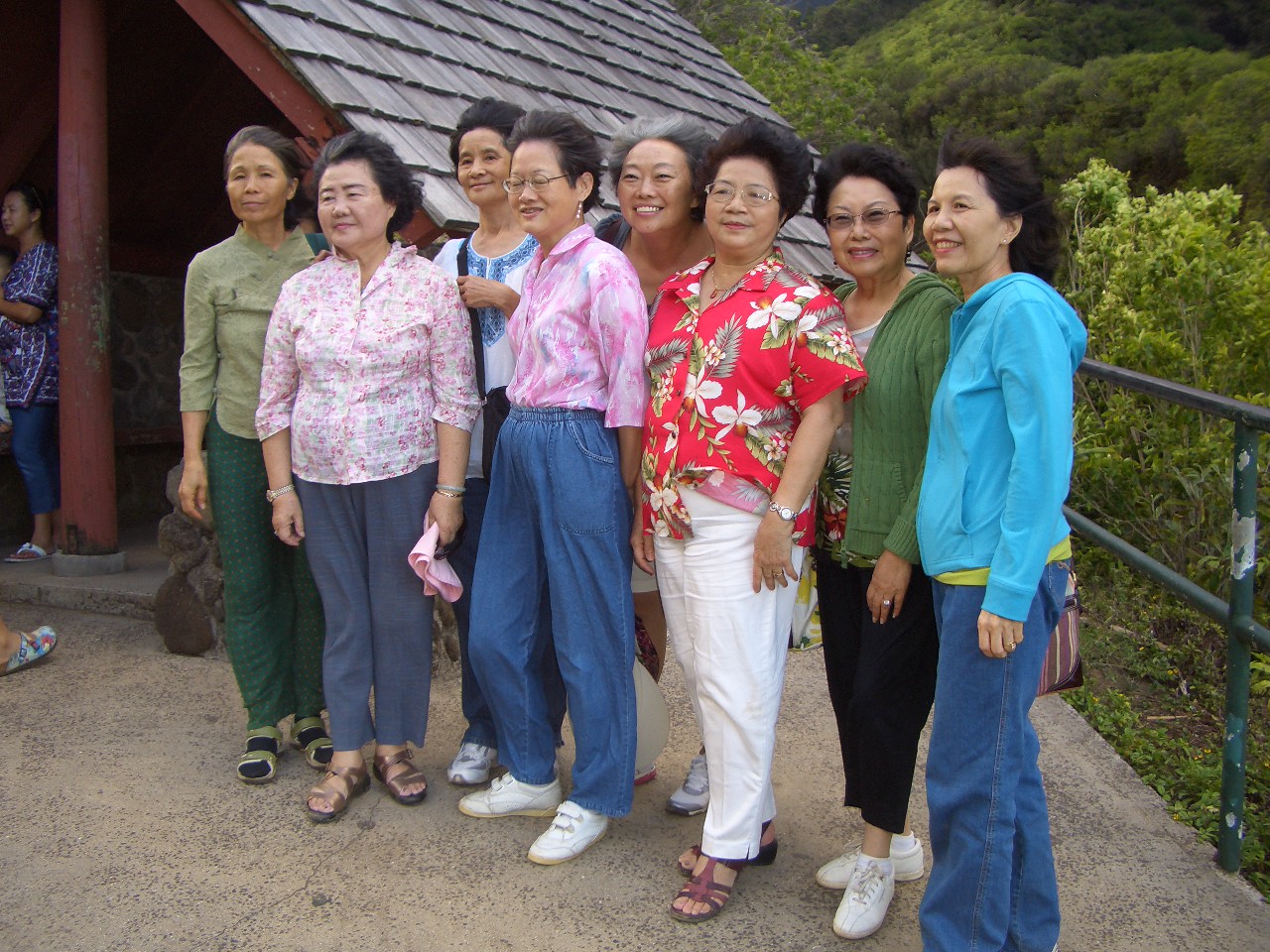
Here are some photos of the reunion, 2010 in Hawaii. Hope you recognize everyone of us & try to match the ladies to the gentlemen. Time flies & these photos of the reunion will become more precious when time goes by.